On-Site CCTV Monitoring and Real-Time Reporting - Nelson, Tasman and Marlborough
On-site CCTV monitoring provides the highest level of surveillance accuracy, responsiveness, and incident verification because trained operators are physically positioned inside your building watching live camera feeds in real time. Unlike remote monitoring, which relies on off-site alerts and delayed verification, on-site operators identify unusual behaviour the moment it begins – not after an alarm is triggered. This makes the service ideal for commercial buildings, warehouses, retail stores, tourism operators, hospitality venues, and high-risk industrial sites that require immediate visibility and rapid decision-making.
ClearWatch NZ delivers structured, real-time on-site surveillance with continuous camera supervision, behaviour pattern analysis, blind spot coverage, evidence capture, and direct escalation to guards or management. Our operators understand your layout, your blind spots, your operational routines, and your risk profile – enabling them to detect irregular activity with far greater accuracy. This page outlines how the service works, why businesses prefer on-site monitoring over remote monitoring, and how it integrates with complementary solutions like like mobile patrols, static guards and alarm response services.
What Is On-Site CCTV Monitoring?
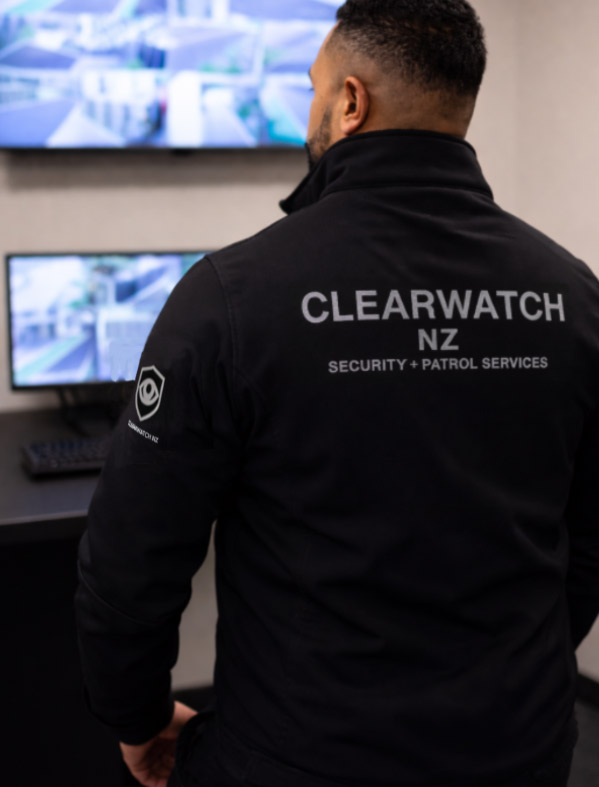
On-site CCTV monitoring places trained operators inside your premises to supervise your camera system continuously. Operators monitor multiple screens simultaneously, rotate focus through priority zones, and respond instantly to irregular behaviour or operational risks. Because they are physically present, they understand lighting conditions, camera angles, blind spots, building layout, and site-specific patterns that remote operators cannot interpret as effectively.
On-site monitoring includes:
- Continuous real-time observation of camera networks
- Context-rich interpretation of camera feeds
- Immediate analysis of suspicious or irregular behaviour
- Direct communication with on-site guards or staff
- Rapid verification of alarms or sensor activity
Scenario example:
In Nelson CBD, an operator may notice a person pacing repeatedly near a rear service door – a pre-incident behaviour that remote systems might miss until the door is forced.
Why Businesses Choose On-Site Monitoring Over Remote Monitoring
Businesses across Nelson, Tasman, and Marlborough choose on-site monitoring because it eliminates the delay between an incident happening and someone recognising it. On-site operators interpret behaviour in context – seeing whether a movement is normal activity or a credible threat. This is especially vital at sites with valuable inventory, machinery, sensitive areas, or after-hours operations.
On-site monitoring offers advantages unavailable through remote services:
- Instant visual confirmation without signal processing or queueing delays
- Greater situational awareness from understanding the physical environment
- Better detection of subtle behavioural anomalies
- Faster escalation to guards, patrol units or management
- Improved evidence quality due to real-time tagging
- Compliance support for insurers and industry requirements
On-Site vs Remote Monitoring
Feature | On-Site Monitoring | Remote Monitoring |
Response Time | Instant | Delayed |
Context Awareness | High | Limited |
Blind Spot Coverage | Yes | No |
Integration with Guards | Direct | Indirect |
Evidence Capture | Immediate | After verification |
Behaviour Analysis | High-level human interpretation | Limited/automated |
Scenario example:
In a Richmond industrial warehouse, forklifts may move after hours. A remote centre might not recognise this as a threat, but an on-site operator knows the facility’s schedule and flags the activity immediately.
What Our On-Site CCTV Monitoring Includes
ClearWatch NZ delivers on-site monitoring using structured procedures, camera-mapping strategies, and operational escalation frameworks. Each operator follows a defined workflow that prioritises high-risk zones and ensures comprehensive coverage throughout the property.
Live Camera Supervision
Continuous supervision is the foundation of effective on-site monitoring. Operators maintain active visibility across all zones, rotating focus between high-activity areas, outdoor areas with limited lighting, or internal corridors where movement must be verified quickly.
Live supervision includes:
- Monitoring entrances, exits, and shared pathways
- Observing high-risk or high-value zones
- Rotating attention between camera groups
- Tracking people or vehicles across multiple angles
- Identifying anomalies such as erratic movement or unusual positioning
Scenario example:
In Blenheim industrial areas, operators may follow unusual vehicle movement circling a property after hours, allowing rapid escalation.
Blind Spot and High-Risk Zone Monitoring
Every property has blind spots, whether caused by camera angle limitations, shelving, parked vehicles, or environmental features. Operators learn these zones and give them additional focus.
High-risk zones include:
- Loading docks and service lanes
- Back-of-house entrances
- Car yards and machinery storage
- Equipment rooms and plant areas
- Long hallways, stairwells, and corner turns
- Side alleys or narrow external passages
Scenario example:
At a Motueka workshop, a camera partially obscured by equipment may hide movement. Operators compensate by adjusting camera cycles and focusing attention strategically.
Incident Detection and Real-Time Alerts
Operators use behavioural interpretation – rather than automated motion triggers – to identify suspicious activity early. They analyse movement patterns, repetition, hesitation, directional changes, or abnormal interactions with the environment.
Incident detection includes:
- Trespass and lingering behaviour
- Forced-entry attempts or probing of doors
- Checking vehicle handles or storage access
- Irregular staff movement in restricted zones
- Internal activity occurring outside scheduled hours
- Objects moved or concealed in blind spots
Additional scenario example:
At a Nelson retail site, an operator may notice a person returning multiple times to inspect a loading area – a potential pre-theft behaviour requiring escalation.
Evidence Capture and Footage Review
Operators capture evidence in real time while the incident is happening – not after the fact. This means the exact sequence of events is preserved, including pre-event and post-event behaviour.
Evidence handling includes:
- Recording time-stamped footage snippets
- Capturing still images for reports
- Tagging and indexing relevant timelines
- Preparing evidence packages for insurance or investigation
- Documenting behavioural context leading up to the event
This means footage includes what happened before, during, and after the incident, giving a complete understanding of the event.
Alarm Panel and Sensor Verification
When alarms trigger, operators verify causes instantly using real-time camera feeds. This reduces false dispatches, improves accuracy, and ensures appropriate escalation.
Verification includes:
- Checking nearby camera angles
- Examining environmental conditions (light, weather, shadows)
- Confirming whether movement is legitimate or suspicious
- Supporting
Reporting and Documentation
Transparent reporting ensures businesses understand exactly what was detected, when it happened, and how it was responded to. Reports support internal safety processes and insurance compliance.
Documentation includes:
- End-of-shift summaries
- Incident notes with visual evidence
- Screenshot and video clip attachments
- Behavioural analysis notes
- Recommended follow-up actions
Industries That Benefit from On-Site Monitoring
On-site monitoring is especially valuable in industries with high-value goods, wide areas, multi-building layouts, or after-hours operations. It provides the visibility required to maintain safety, prevent incidents, and support operational continuity.
Industries include:
- Commercial and corporate buildings
- Retail stores, boutiques, and shopping centres
- Warehouses and distribution facilities
- Manufacturing and processing sites
- Car yards, machinery lots, and equipment yards
- Tourism and hospitality venues
- Schools, medical centres, and community buildings
How On-Site CCTV Monitoring Works - Our Process
ClearWatch NZ follows a structured five-step operational method to ensure accurate monitoring and consistent incident detection.
Step 1 - Site Assessment and Camera Mapping
We analyse your property layout, lighting, camera positioning, blind spots, and traffic flow. The operator’s monitoring strategy is built around these environmental characteristics.
Step 2 - Monitoring Setup and Operator Instructions
Operators receive custom instructions tailored to your site’s risks. Monitoring stations are set up with multi-screen displays, camera groups, and clear escalation procedures.
Step 3 - Real-Time Surveillance
Operators follow structured viewing cycles, focusing on risk areas during peak vulnerability periods. They cross-check activity across angles to build context.
Step 4 - Incident Response and Communication
When behaviour appears suspicious, operators immediately notify guards or management. Escalation is fast, direct, and based on clearly defined protocols.
Step 5 - Reporting and Evidence Handling
Detailed logs and objective reports are created for every shift or incident. These provide clarity and transparency for internal teams.
Integrating Monitoring with Guards, Patrols and Alarm Response
On-site CCTV monitoring is most effective when integrated with ClearWatch NZ’s wider security ecosystem. Operators detect activity in real time, while response teams act immediately.
Integrated security benefits:
- Guards respond within seconds to operator alerts
- Patrols verify external activity quickly
- Alarm response becomes more accurate and efficient
- After-hours operations gain deeper visibility
- Evidence is captured before escalation
Regions We Serve
ClearWatch NZ provides professional on-site CCTV monitoring across Nelson, Tasman, and Marlborough, adapting procedures to suit local industry requirements and environmental conditions.
Nelson
Monitoring support for CBD retail, Tahunanui tourism operators, industrial parks, waterfront commercial sites, and late-night businesses.
Tasman District
Services cover Richmond warehousing, Motueka retail hubs, Mapua tourism businesses, and rural industrial sites requiring high-visibility monitoring.
Marlborough
Marlborough monitoring includes Blenheim commercial areas, vineyards, Picton waterfront sites, accommodation providers, and storage facilities with after-hours movement.
Frequently Asked Questions
What is on-site CCTV monitoring?
On-site CCTV monitoring places trained security operators inside your building to watch live camera feeds continuously. This allows immediate detection of irregular behaviour, environmental risks, or security threats.
How is it different from remote monitoring?
Remote services react after an algorithm triggers an alert, while on-site operators see activity as it happens. They understand your building layout and blind spots, enabling faster and more accurate response.
Do you provide 24/7 monitoring?
Yes. ClearWatch NZ offers full-time, part-time, and after-hours monitoring depending on your operational needs.
Can you monitor both internal and external cameras?
Absolutely. All accessible camera zones can be supervised, including entrances, storage areas, equipment rooms, loading docks, corridors, car parks, and machinery yards.
How quickly can operators verify an alarm?
Immediately. Operators visually confirm alarm triggers in real time, reducing false callouts and improving response accuracy.
Which industries benefit most?
Warehouses, retail stores, car yards, manufacturing plants, tourism accommodation, and any site with high-value goods or operational complexity.
Do you cover Nelson, Tasman, and Marlborough?
Yes. We provide full regional coverage with monitoring procedures tailored to each area’s risk patterns.
Request CCTV Monitoring and Reporting
Strengthen your security posture with real-time, on-site camera supervision. ClearWatch NZ provides accurate detection, immediate response, and professional reporting through trained operators who understand your property.